

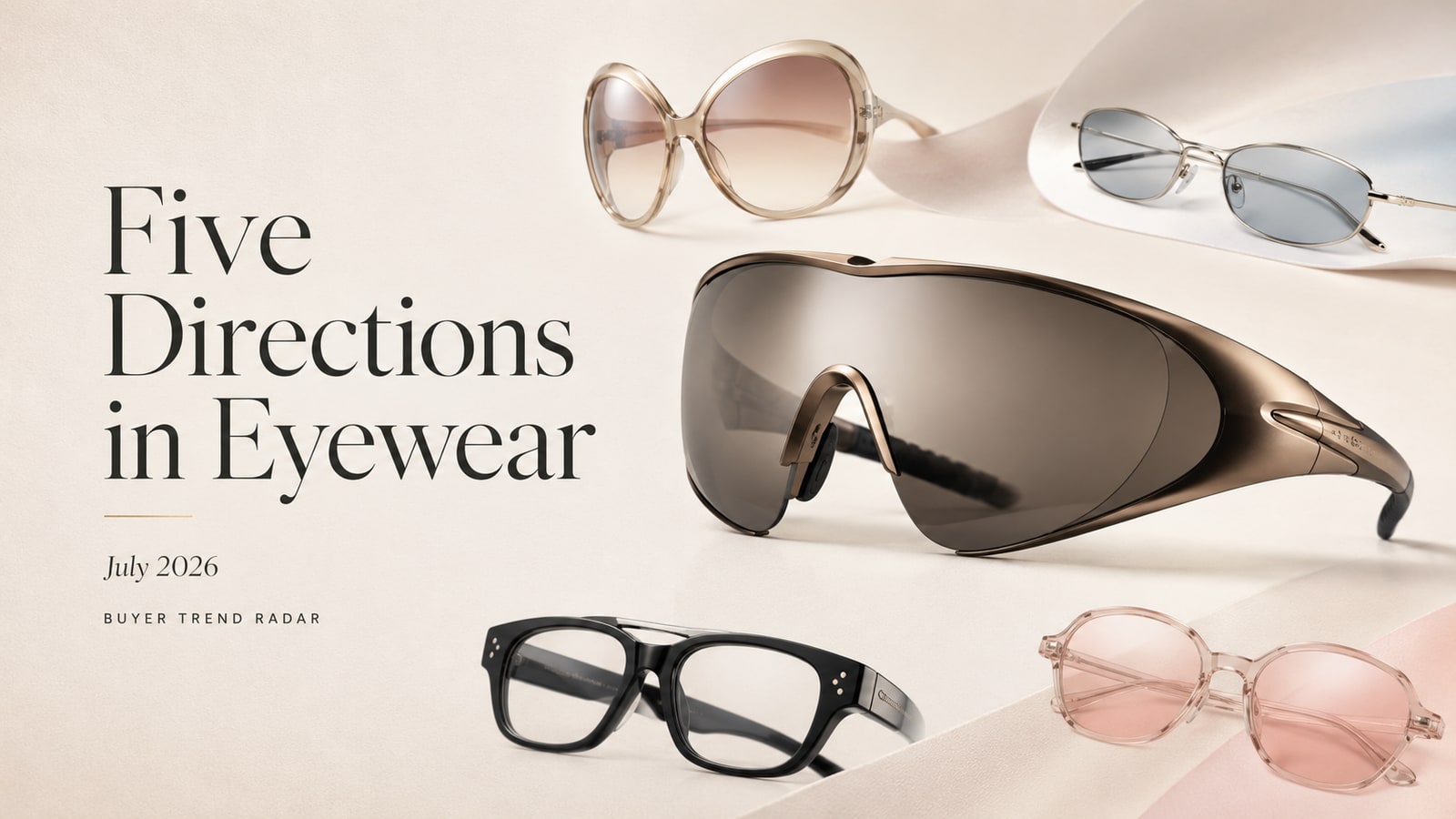
The clearest eyewear signal this week is not a single frame shape. It is a widening split between high-impact silhouettes and lighter, narrower counterpoints. Sleek wraparound sunglasses appeared in fresh Paris Couture Week street style, while summer fashion coverage continues to support shields, oversized bug-eye shapes, slim 1990s proportions, wire frames, and substantial acetate.
For brand buyers, visibility is only the first filter. The useful question is whether a signal deserves an immediate sample, a small market test, or no action yet. This weekly radar converts current fashion coverage into product architecture, fit, color, SKU, and sourcing decisions. It is directional guidance, not a sales forecast.
This week's decision: Sample a sleek wrap or softened shield now, add one oversized statement shape, keep a slim or wire option as a counterbalance, and test fashion colors in a controlled capsule rather than spreading the first order across too many combinations.
A fresh street-style report from Paris, published on July 9, identified sporty wraparound sunglasses among the visible directions around Couture Week. That matters because it moves the sport-to-street idea beyond a runway reference and into current styling. Vogue's late-June shield edit provides a second signal, showing fashion, aviator-influenced, runway-wrap, full-wrap, and oversized interpretations within the same broad family.
At the same time, oversized bug-eye shapes remain prominent in runway and editor coverage, while slim 1990s-style sunglasses and wire frames create a visibly different option for buyers who do not want an entire collection built around scale and coverage. Thick acetate continues to support statement construction, and pale frames or colored lenses provide a lower-commitment way to update proven shapes.
Google's official Summergeist report says U.S. searches for summer trends reached record highs in 2026. That supports the timing of summer trend content, but the reviewed report does not publish eyewear-specific search volume. We therefore use current editorial, runway, and street-style evidence as directional signals and do not present invented keyword numbers.
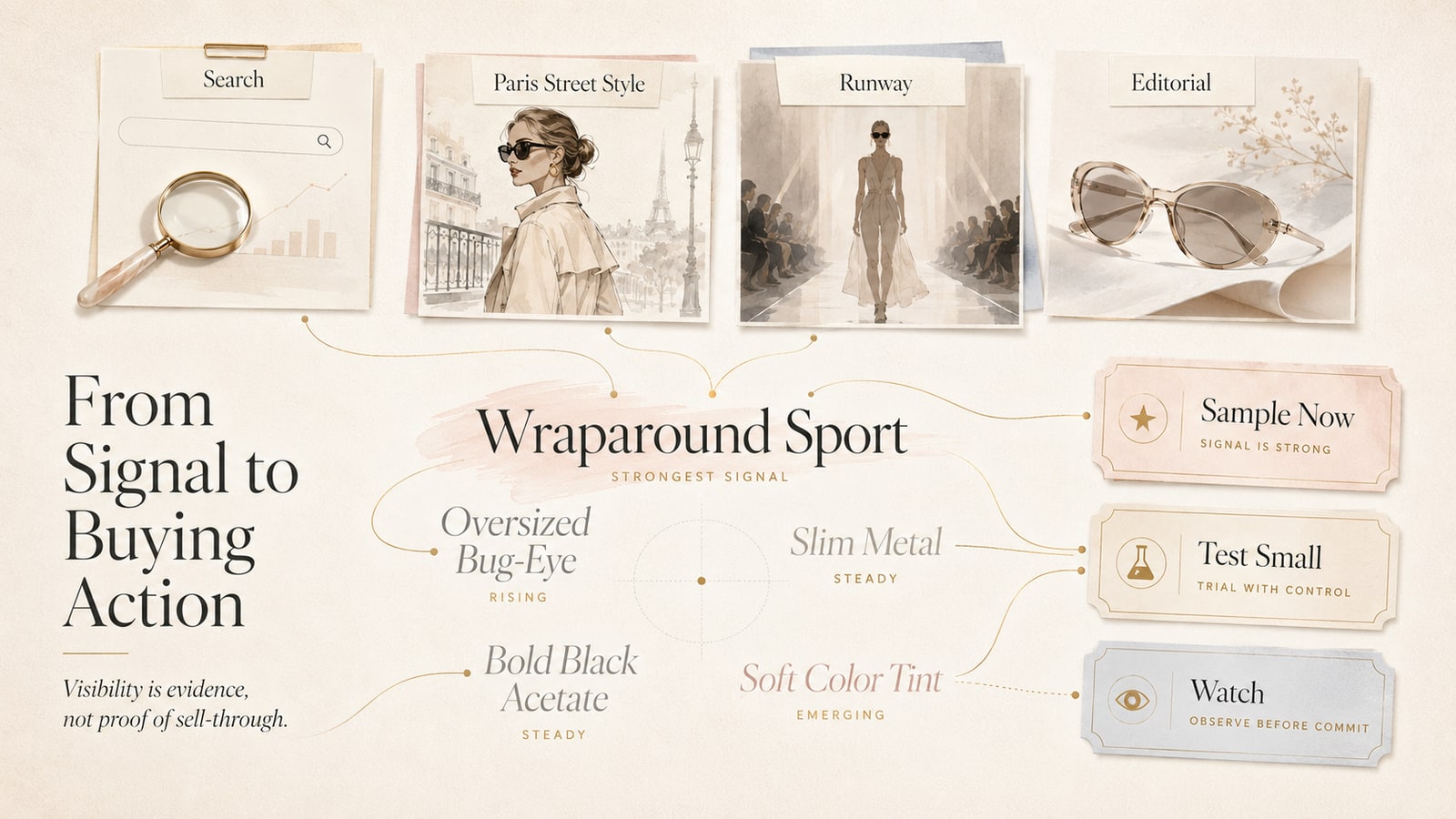
Confidence: High | Action: Sample now
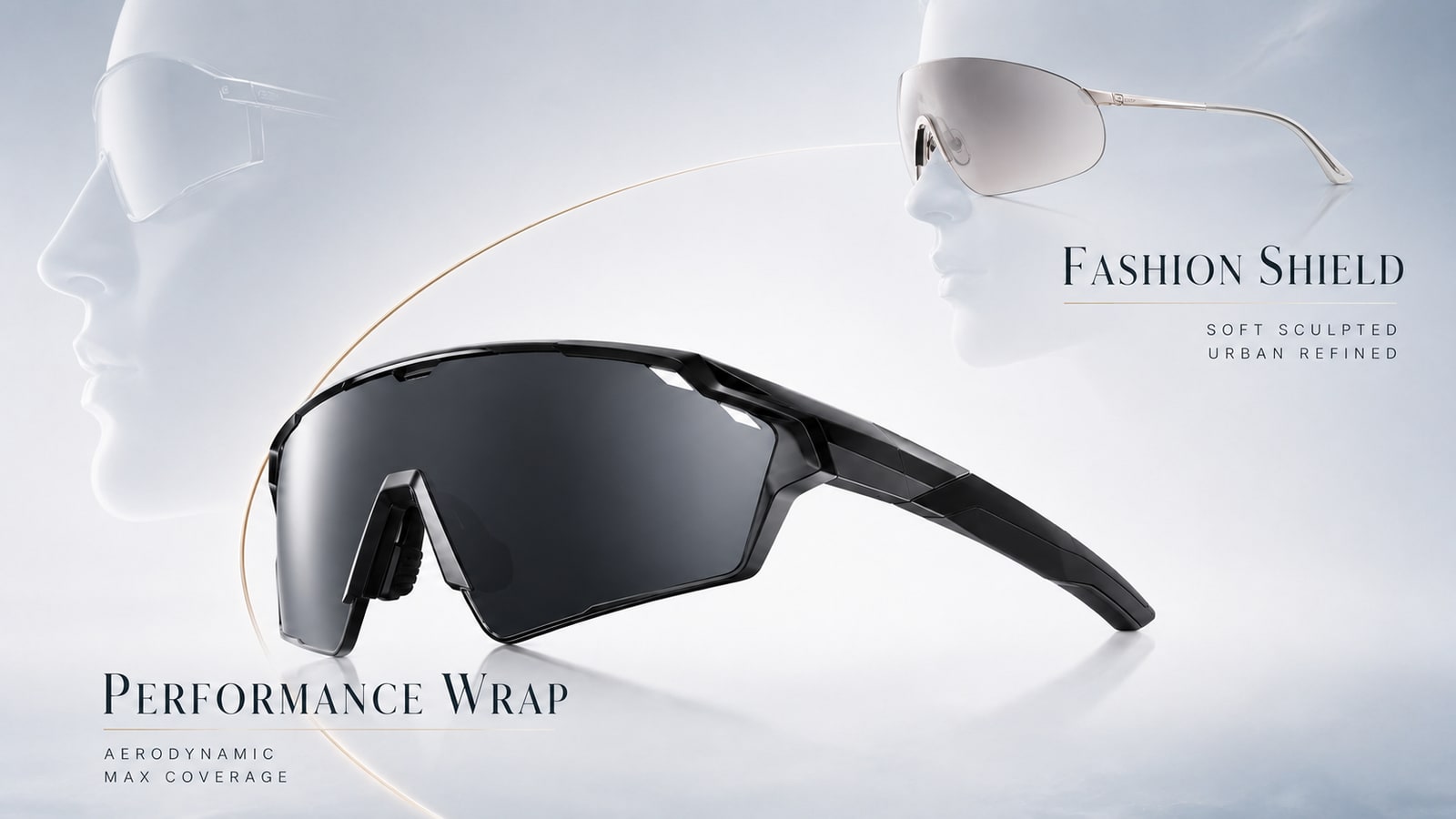
This is the strongest current signal because fresh Paris street style reinforces the shield and wrap direction already visible in summer editorial coverage. Buyers should not reduce the trend to one technical cycling frame. A more resilient sample plan compares two interpretations: a performance-led wrap with clear coverage and stability, and a cleaner fashion shield with softer temple geometry and easier everyday styling.
Review actual samples for lens-to-face clearance, nose contact, temple pressure, side coverage, optical comfort, helmet or cap interaction, and ventilation. A strong silhouette is not enough. Buyers can start with Jingseyewear's sports sunglasses range and compare structural routes before fixing colors or coatings.
Confidence: High | Action: Sample one controlled statement shape
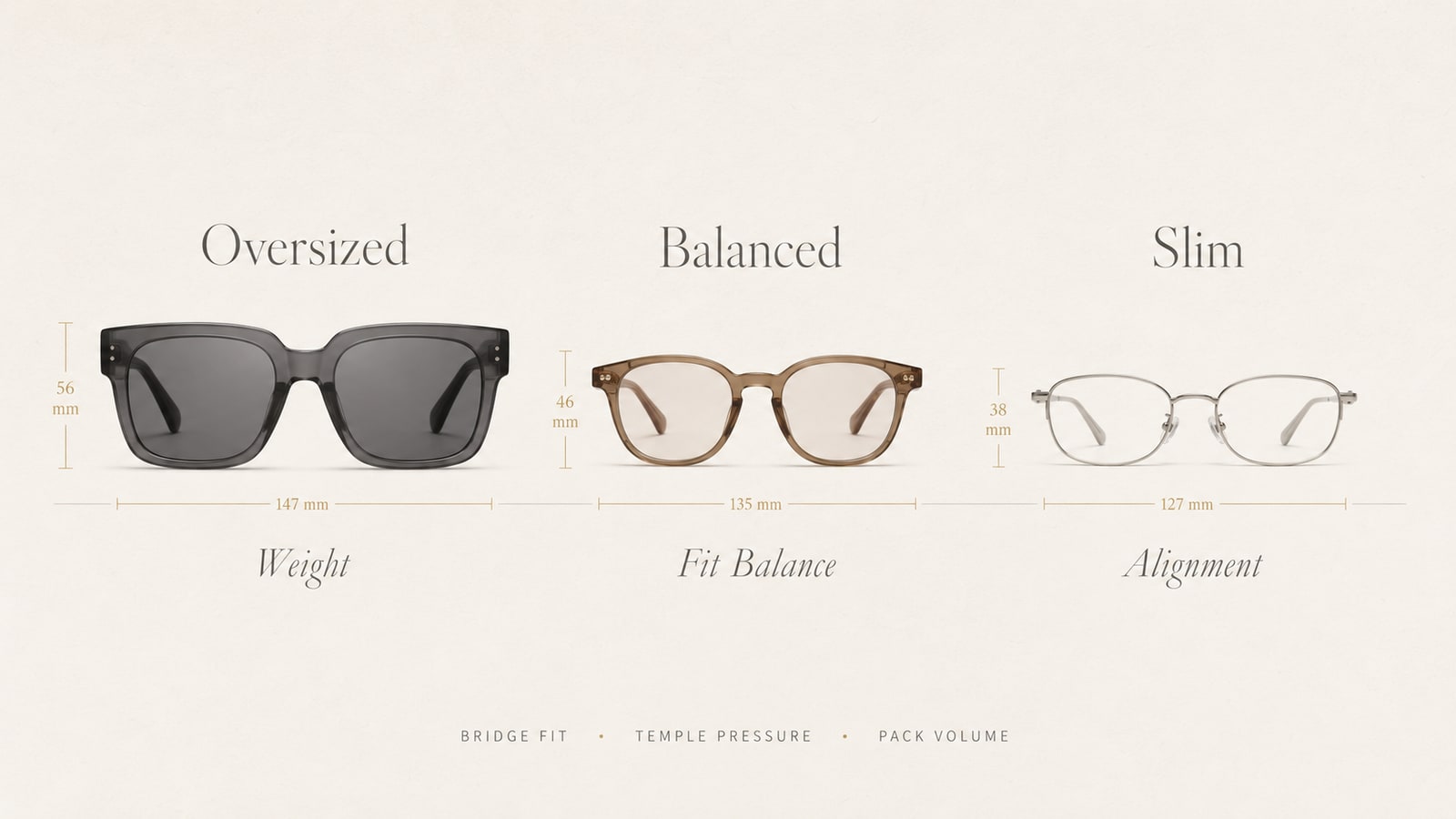
Oversized frames create immediate merchandising impact, but they carry more fit and inventory risk than a familiar medium-size silhouette. Larger fronts may increase weight, alter bridge balance, create cheek contact, require longer temples, and need a larger case. Ask for front width, lens height, bridge geometry, temple length, product weight, and packaging dimensions before committing to a large color assortment.
Confidence: Medium-high | Action: Use as a collection counterbalance
Slim rectangles, narrow ovals, and smaller wire shapes answer a different styling need from shields and bug-eye frames. Their commercial value is not only trend relevance; they prevent a collection from becoming too visually repetitive. For wire constructions, review rim shape, solder or connection points, plating consistency, nose-pad alignment, temple straightness, and lens retention. A delicate look still needs a clear durability and handling brief.
Confidence: Medium-high | Action: Build around one wearable core shape
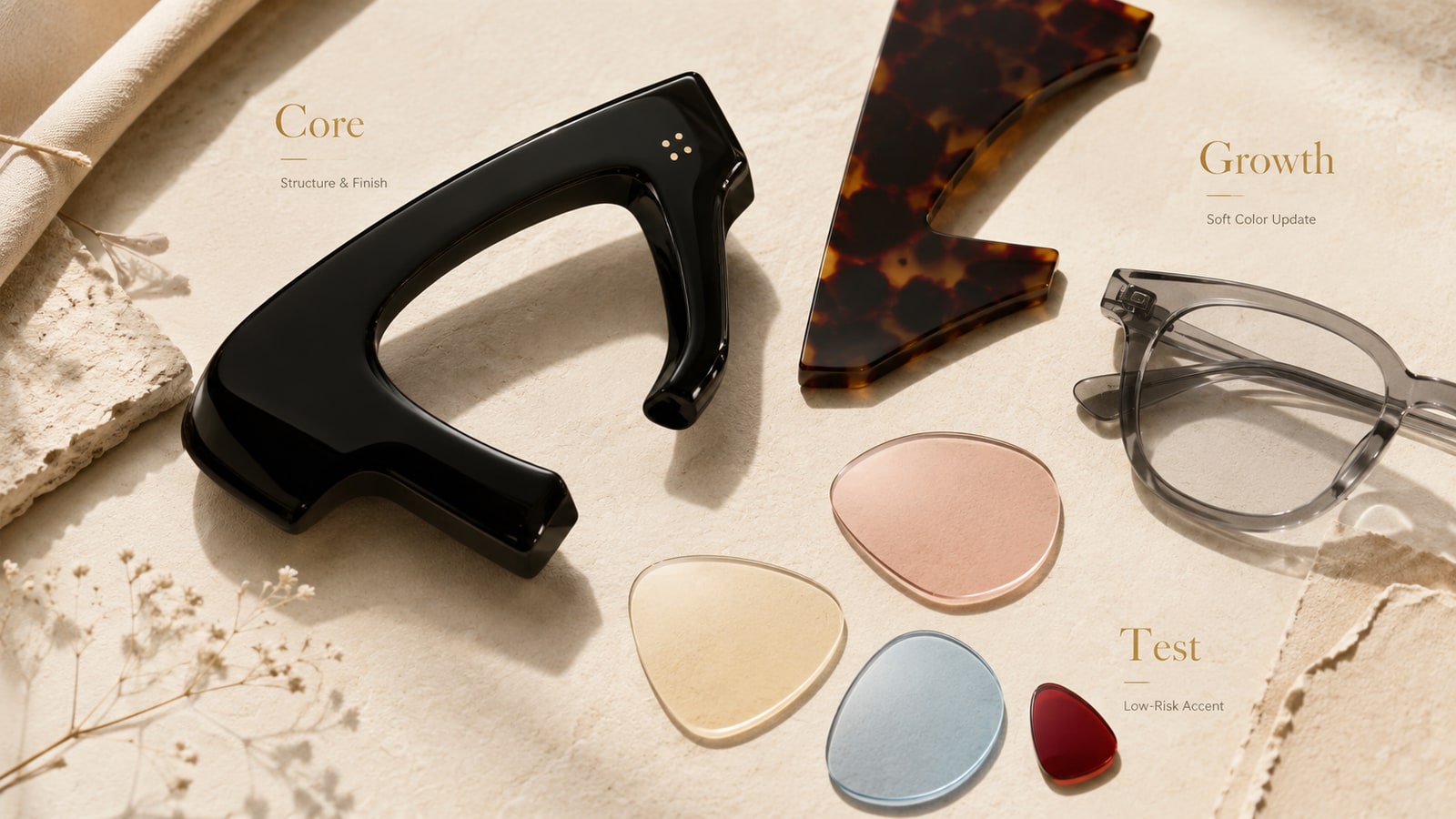
Thick acetate can communicate value through depth, polish, bevels, and sculpted temples without depending on a temporary lens color. Start with one wearable black or dark tortoise base before adding more directional colors. Sample review should cover surface polish, edge transitions, left-right symmetry, hinge feel, color consistency, frame adjustment, and total weight. Material selection should be confirmed separately from appearance; the same visual direction can involve different construction routes.
Confidence: Medium | Action: Test small
Butter yellow, pastel pink, white, and red-lens accents can refresh a proven frame faster than developing a completely new structure. They are also more sensitive to market, season, skin-tone styling, photography, and merchandising. Keep the first test focused: one proven frame, one or two fashion colors, and a controlled lens specification. Lens appearance does not establish UV performance, polarization, or visible light transmission, so buyers should define those fields separately through coating options and a written lens material specification.
| Direction | Confidence | Recommended action | Main sample check | Inventory risk |
|---|---|---|---|---|
| Sleek wrap / shield | High | Sample now | Curve, fit, clearance, optical comfort | Medium if color count is controlled |
| Oversized bug-eye | High | One statement sample | Weight, bridge, cheek contact, case size | Medium-high |
| Slim / wire | Medium-high | Collection counterbalance | Alignment, plating, connections, lens retention | Medium |
| Thick acetate | Medium-high | Build one core shape | Polish, symmetry, hinge feel, weight | Medium |
| Pastel / white / red lens | Medium | Small capsule test | Color approval, VLT, coating, photography | High if spread across many SKUs |
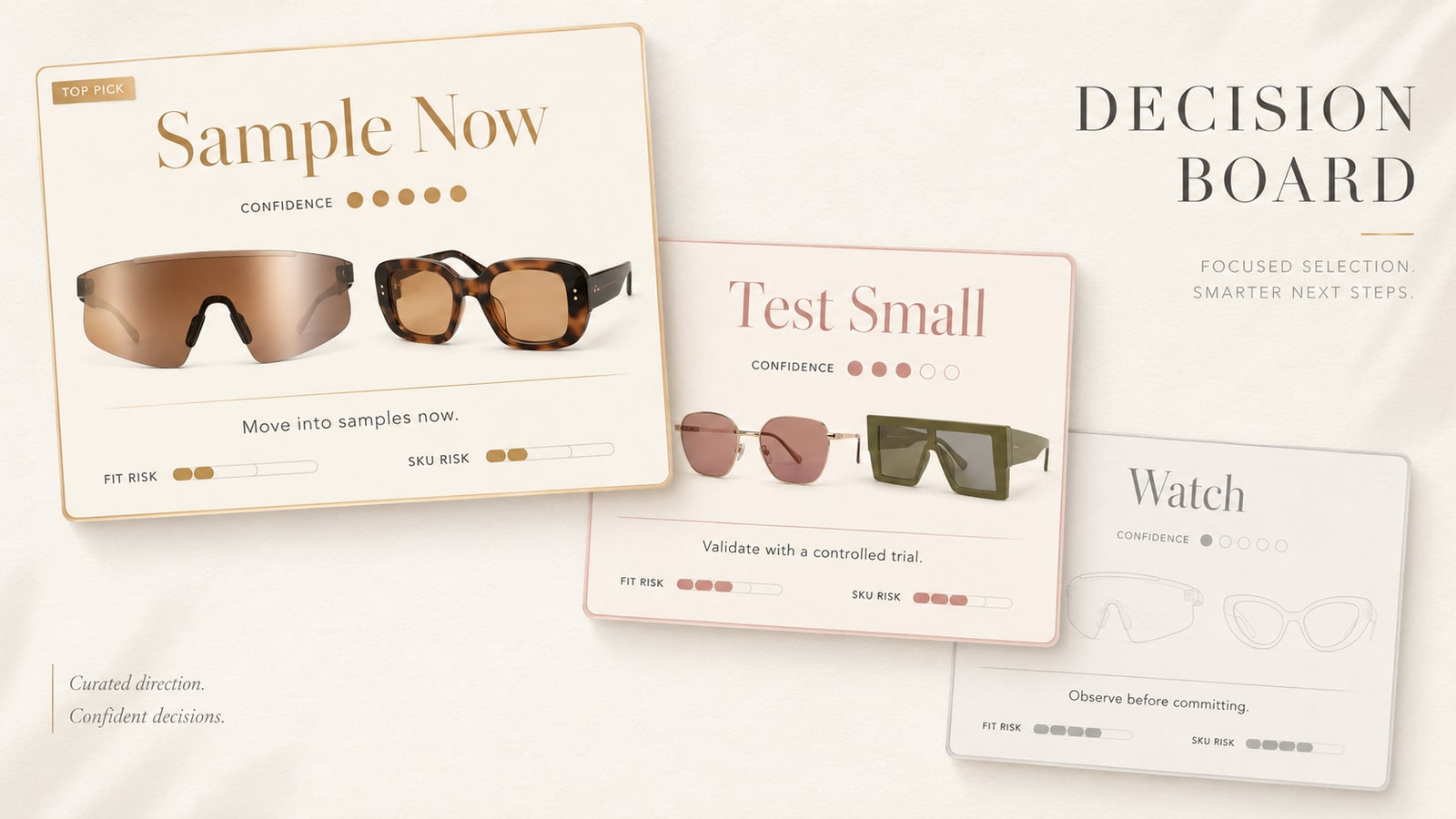
A sleek wrap or softened shield, one wearable oversized statement frame, and one slim or wire counterpoint. Keep early samples in neutral colors so the team can judge architecture and fit before color affects the decision.
Butter yellow, soft pink, white, red-lens accents, extreme bug-eye proportions, and highly sculpted temples. Use one variable at a time where possible, so sales feedback can identify whether the shape, color, lens, or price drove the result.
Direct copies of recognizable runway products, a first order fragmented across many frame-lens-packaging combinations, and any product positioned with performance claims that have not been defined and verified. Editorial visibility alone does not justify tooling or a wide bulk commitment.
| Check | Buyer question | Approval evidence |
|---|---|---|
| 1. Silhouette | Does the product express the intended trend without copying a known design? | Approved front, side and top views |
| 2. Fit | Does it fit representative wearers in the target market? | Wear-test notes and measurements |
| 3. Weight and balance | Is pressure concentrated at the nose, temples or ears? | Product weight and wearer feedback |
| 4. Lens brief | Are material, tint, VLT, UV requirement, polarization and coating separated? | Written lens specification |
| 5. Finish and color | Can production match the approved frame and lens colors? | Signed color sample under agreed lighting |
| 6. Branding | Is the logo size, position, color and method documented? | Artwork and approved logo sample |
| 7. Packaging and QC | Does the case fit, and what will bulk production be checked against? | Approved pack-out and inspection checklist |
For lightweight sport-led structures, buyers can review available PC and TR90 sunglasses as development references. Material names, however, should be confirmed through the quotation and sample record rather than inferred from appearance.
A practical first assortment gives each style a job. Core frames protect continuity and reorders. Growth styles bring current relevance without extreme fit or color risk. Statement styles create campaign impact. Test styles collect evidence about a new color, scale, or lens treatment.
Illustrative pilot architecture:
Use proven carryovers as the base, add a limited number of current growth shapes, select one campaign-level statement frame, and reserve the smallest commitment for experimental colors. The correct mix depends on the target customer, price point, channel, climate, launch calendar, and existing sales data; this is a planning framework, not market-share data.
Before asking for a quotation, decide which role each SKU plays. Jingseyewear's OEM and ODM services and development support can be used to compare existing-platform, modified ODM, and deeper custom routes.
| Brief field | What to provide | Why it matters |
|---|---|---|
| Market and wearer | Country, channel, price position, target face fit | Guides size, styling and compliance discussion |
| Trend role | Core, growth, statement or test | Prevents every SKU from receiving the same investment |
| Construction | Reference architecture, dimensions and material preference | Separates silhouette from manufacturable detail |
| Lens | Material, tint, VLT, UV requirement, polarization, coating | Prevents color from being mistaken for performance |
| SKU plan | Frame colors, lens colors, logo method and packaging | Reveals MOQ and complexity before sampling expands |
| Timeline | Sample review date, launch date and required tests | Allows a realistic development route to be discussed |
Current July street-style evidence suggests the sport-to-street direction is still active. Timing nevertheless depends on the brand's sample cycle, sales market, launch date, and ability to differentiate the product without copying a recognizable design.
No. A single proven architecture can sometimes carry a current color, lens, or temple treatment. This is usually easier to test than combining a new structure, new color, new lens, new logo process, and new packaging in one first order.
There is no universal number. Base the test on the supplier's actual minimums, the channel's selling capacity, existing customer data, photography needs, launch timing, and the number of other variables already in the SKU.
Treating a visual reference as a complete specification. A product still needs documented dimensions, fit, material, lens, color, logo, packaging, sample approval, testing, and bulk QC requirements.
Send Jingseyewear your target market, price position, preferred trend directions, quantity range, lens needs, launch timing, and current best sellers. The team can help compare existing-platform, modified ODM, and custom development routes.
Discuss Your Eyewear Sample Plan


Please Read On, Stay Posted, Subscribe, And We Welcome You To Tell Us What You Think.



Copyright @ 2026 Xiamen Jings Eyewear Co., Ltd. All Rights Reserved.
 Network Supported